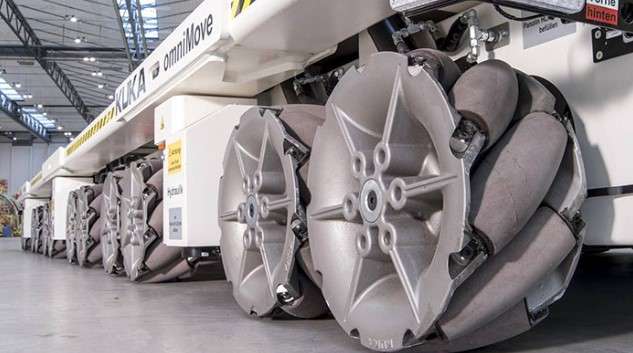
The concept of Mecanum wheels has fascinated engineers and technology enthusiasts for decades. With their ability to move in any direction—forward, sideways, diagonally, and even rotate in place—they seem like the perfect solution for urban mobility and tight parking spaces. Yet, despite being invented in the 1950s and patented in 1972, they have never been adopted in mainstream commercial cars.
So why has such an innovative technology failed to make its way into everyday vehicles?
What Are Mecanum Wheels?
Mecanum wheels (also known as omnidirectional wheels) are a unique type of wheel design featuring rollers mounted at a 45-degree angle around the rim.
This design allows a vehicle equipped with four independently controlled wheels to move in any direction without turning the steering wheel.
Key Capabilities
- Sideways (lateral) movement
- Diagonal motion
- Zero-radius turning (rotate in place)
- Precise navigation in tight spaces
These features make Mecanum wheels extremely popular in:
- Robotics
- Automated guided vehicles (AGVs)
- Warehousing systems
However, when applied to commercial cars, things become much more complicated.
1. The Biggest Limitation: Poor Traction and Grip
Why Traction Matters in Cars
Traditional car tires are designed to maximize contact with the road, ensuring strong grip for:
- Acceleration
- Braking
- Cornering
Mecanum wheels, however, sacrifice this stability for mobility.
The Core Problem
Because of their roller-based design, only a small portion of the wheel touches the ground at any time, significantly reducing friction.
Consequences
- Increased slipping, especially on wet or uneven roads
- Poor braking performance
- Reduced stability at high speeds
👉 In real-world driving, low traction equals danger, making Mecanum wheels unsuitable for passenger vehicles where safety is critical.
2. Limited Speed and Efficiency
Why Speed is Critical in Automotive Design
Commercial cars must operate efficiently at high speeds on highways. However, Mecanum wheels struggle in this area.
Key Issues
- Energy loss due to roller movement
- Reduced forward propulsion efficiency
- Increased friction in multiple directions
As a result, vehicles using Mecanum wheels are typically:
- Slower
- Less energy-efficient
- More prone to instability at high speeds
👉 This makes them impractical for long-distance travel or highway driving.
3. Complex Mechanical Design
Traditional Wheels vs. Mecanum Wheels
A standard car wheel is simple:
- Tire
- Rim
- Axle
Mecanum wheels, on the other hand, consist of:
- Dozens of small rollers
- Bearings for each roller
- Independent drive systems
Why This Matters
The increased complexity leads to:
- More points of failure
- Higher maintenance requirements
- Greater manufacturing difficulty
In fact, each wheel often requires independent motor control and synchronization, making the entire drivetrain far more complex.
👉 For mass production, simplicity is key—and Mecanum wheels fail this test.
4. High Production and Maintenance Costs
Cost is King in the Automotive Industry
Automakers prioritize solutions that are:
- Scalable
- Affordable
- Easy to maintain
Mecanum wheels fall short on all three fronts.
Why They’re Expensive
- Complex manufacturing process
- More materials and components
- Advanced control systems required
Additionally:
- Repairs are more difficult
- Replacement parts are costly
According to industry analysis, both production and maintenance costs are significantly higher than traditional tires.
👉 This makes them economically unviable for mass-market vehicles.
5. Low Load Capacity and Durability
Real-World Driving Conditions
Cars must handle:
- Heavy loads (passengers + cargo)
- Rough roads
- Long-term wear and tear
Mecanum wheels are not designed for such demands.
Key Weaknesses
- Load distributed across small rollers
- Increased wear on moving parts
- Vulnerability to road debris
They are also less durable under high stress and continuous use.
👉 This limits their application to controlled environments like warehouses—not public roads.
6. Poor Performance on Rough Terrain
Unlike traditional tires, Mecanum wheels struggle on:
- Uneven roads
- Gravel
- Mud
- Potholes
The small rollers can:
- Get stuck
- Wear out quickly
- Lose contact with the ground
This makes them unsuitable for real-world road conditions, especially in developing regions or off-road environments.
7. Difficult Control and Driving Experience
A New Driving Paradigm
Driving a Mecanum-equipped vehicle is fundamentally different from traditional cars.
Challenges
- Requires advanced control algorithms
- Difficult for average drivers to adapt
- Sensitive to weight distribution
Even slight imbalance can cause:
- Uneven movement
- Reduced control accuracy
- Increased risk of malfunction
👉 For everyday users, simplicity and predictability are essential—something Mecanum wheels lack.
8. Energy Inefficiency
Why Efficiency Matters
Modern vehicles—especially electric cars—prioritize:
- Energy efficiency
- Range optimization
Mecanum wheels introduce:
- Additional friction
- Energy loss through rollers
- Heavier mechanical systems
👉 This results in reduced battery life and fuel efficiency, making them impractical for modern automotive standards.
9. Lack of Market Demand
Innovation vs. Practical Need
While Mecanum wheels offer impressive maneuverability, most drivers don’t actually need:
- Sideways driving
- Omnidirectional movement
Instead, they prioritize:
- Safety
- Comfort
- Cost
- Reliability
Because of this, there is little market demand for such technology in passenger vehicles.
👉 Without demand, manufacturers have no incentive to invest.
10. Where Mecanum Wheels Actually Excel
Despite their limitations, Mecanum wheels are highly effective in specific use cases:
Ideal Applications
- Robotics
- Warehouse automation
- Industrial transport systems
- Research platforms
In these environments:
- Speed is less important
- Surfaces are smooth
- Precision is critical
👉 This is why Mecanum wheels continue to thrive in niche industries rather than consumer vehicles.
Future Potential: Will Mecanum Wheels Ever Be Used in Cars?
Possible Improvements
Researchers are exploring:
- Stronger materials
- Better roller designs
- Advanced control systems
If these challenges are solved, we might see:
- Hybrid mobility systems
- Specialized urban vehicles
- Autonomous transport solutions
However, for now, traditional wheels remain far superior for general transportation.
Conclusion
Mecanum wheels represent an impressive engineering innovation, offering unmatched maneuverability and flexibility. However, when evaluated against real-world automotive requirements, they fall short in several critical areas:
Key Takeaways
- Low traction compromises safety
- Limited speed reduces practicality
- High cost and complexity hinder mass adoption
- Poor durability affects long-term use
- Minimal demand limits industry investment
Ultimately, the reason Mecanum wheels have not been used in commercial cars for over 50 years comes down to one simple truth:
👉 They solve a problem that most drivers don’t have—while introducing many new ones.
For now, they remain a fascinating example of how innovation must align with practicality to succeed in the real world.