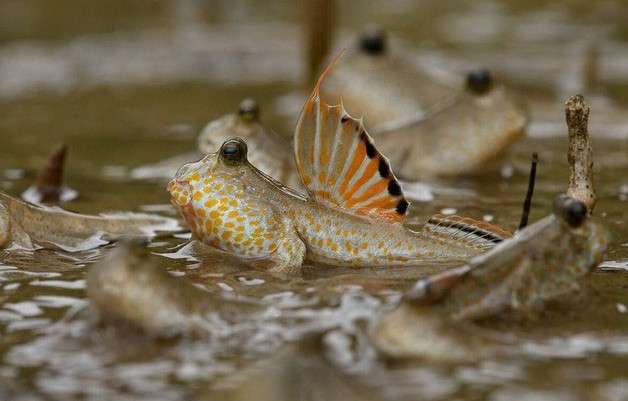
The natural world is filled with fascinating adaptations, but few are as intriguing as the behavior of the mudskipper—a fish that appears to defy biology by spending much of its life on land. While this amphibious lifestyle may seem like a remarkable evolutionary advantage, recent observations suggest something more urgent: in many cases, mudskippers are not choosing land—they are being forced onto it.
In this in-depth SEO-optimized article, we explore why mudskippers are compelled to live on land, the environmental pressures driving this behavior, and what it reveals about climate change, pollution, and the future of aquatic ecosystems.
What Is a Mudskipper?
Mudskippers are amphibious fish belonging to the genus Periophthalmus. They are commonly found in coastal mudflats, mangroves, and estuaries across tropical and subtropical regions such as Southeast Asia.
What makes mudskippers unique is their ability to:
- Breathe through their skin and mouth lining
- Use pectoral fins to “walk” on land
- Survive in both aquatic and terrestrial environments
These adaptations make them one of the most extraordinary examples of evolutionary transition between water and land.
Why Are Mudskippers Forced to Live on Land?
Despite their amphibious nature, mudskippers are fundamentally aquatic animals. Their increasing reliance on land is not simply natural behavior—it is often a survival response to environmental stress.
1. Oxygen Depletion in Water
The most critical factor driving mudskippers out of the water is low oxygen levels (hypoxia).
What Causes Oxygen Depletion?
- Eutrophication (excess nutrients causing algal blooms)
- High water temperatures, reducing oxygen solubility
- Slow or stagnant water flow
When algae bloom excessively, they consume oxygen during decomposition, leaving aquatic life struggling to breathe.
As oxygen levels drop, mudskippers are forced to leave the water temporarily to absorb oxygen directly from the air, where oxygen concentration is significantly higher.
2. Water Pollution and Habitat Degradation
Another major driver is water pollution, largely caused by human activity.
Common Sources of Pollution
- Industrial wastewater
- Agricultural chemicals (pesticides, fertilizers)
- Household waste
These pollutants disrupt water chemistry, reducing oxygen levels and damaging ecosystems.
Impact on Mudskippers
- Reduced food supply (loss of algae and microorganisms)
- Toxic exposure affecting reproduction
- Altered pH levels damaging survival conditions
As their aquatic habitat becomes uninhabitable, mudskippers are pushed onto land as a last resort.
3. Climate Change and Rising Temperatures
Climate change plays a crucial role in altering aquatic environments.
Key Effects
- Warmer water holds less dissolved oxygen
- Increased evaporation leads to shallower habitats
- Extreme weather disrupts ecosystems
These changes create hostile living conditions, forcing mudskippers to adapt quickly or relocate.
4. Loss of Natural Habitat
Coastal ecosystems such as mangroves are being destroyed due to:
- Urban development
- Overfishing
- Industrial expansion
This leads to fragmented habitats, making it difficult for mudskippers to survive underwater.
As a result, they increasingly rely on land environments such as:
- Mudflats
- Wet sand areas
- Coastal vegetation zones
5. Food Scarcity in Water
Mudskippers primarily feed on algae and small organisms found in muddy substrates.
However, pollution and ecological imbalance can:
- Destroy algae populations
- Disrupt food chains
- Reduce biodiversity
Without sufficient food underwater, mudskippers are forced to search for alternative feeding grounds on land.
How Mudskippers Survive on Land
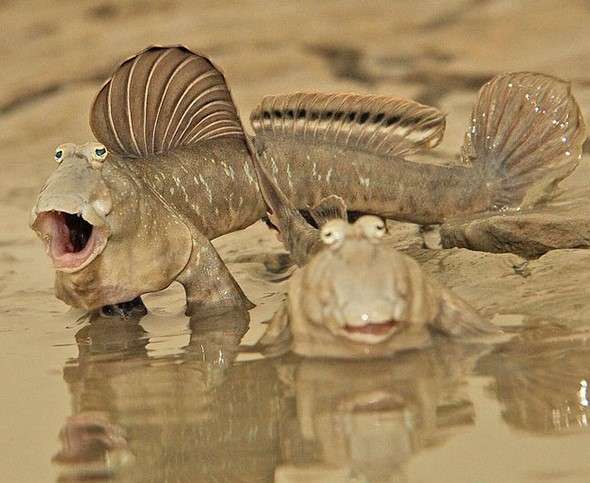
Even though they are forced onto land, mudskippers possess remarkable adaptations that allow them to survive.
1. Breathing Adaptations
Mudskippers can:
- Absorb oxygen through moist skin
- Store water in their gill chambers
- Use cutaneous respiration
However, they must remain moist at all times, or they risk dehydration.
2. Movement on Land
Unlike typical fish, mudskippers use their fins to:
- Crawl
- Jump
- Climb (even small roots or branches)
This mobility allows them to escape predators and explore new environments.
3. Behavioral Adaptations
Mudskippers display unique behaviors such as:
- Digging burrows in mud
- Territorial displays
- Air-gulping for oxygen
These behaviors enhance their survival in both aquatic and terrestrial conditions.
The Risks of Living on Land
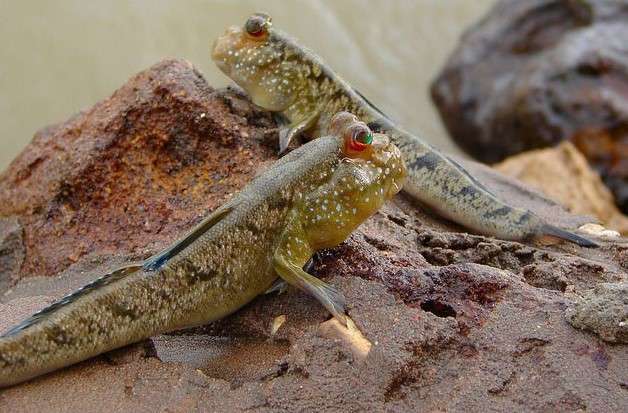
Although land provides temporary relief, it is not a perfect solution.
1. Dehydration
Mudskippers rely on moisture to breathe. On land:
- Dry conditions can quickly become fatal
- They must stay near water or wet mud
2. Predation
On land, mudskippers face new predators such as:
- Birds
- Reptiles
- Larger terrestrial animals
3. Temperature Fluctuations
Unlike water, land environments experience:
- Rapid temperature changes
- Extreme heat exposure
These factors can stress mudskippers and reduce survival rates.
4. Limited Survival Time
Mudskippers cannot live permanently on land. Their terrestrial activity is:
- Temporary
- Dependent on environmental conditions
Eventually, they must return to water—if conditions allow.
Evolution vs. Environmental Pressure
It is important to distinguish between:
Natural Evolution
Mudskippers evolved over millions of years to adapt to both land and water.
Forced Behavior
Today, many mudskippers are not evolving toward land life—they are reacting to environmental degradation.
This distinction highlights a critical issue:
The shift toward land is not always a sign of progress—it can be a sign of ecological crisis.
What Mudskippers Teach Us About the Environment
Mudskippers serve as bioindicators, meaning their behavior reflects environmental health.
Key Lessons
- Oxygen depletion signals ecosystem imbalance
- Pollution directly impacts biodiversity
- Climate change affects even resilient species
When mudskippers are forced onto land, it is often a warning that:
👉 Aquatic ecosystems are under serious stress
How Humans Can Help Protect Mudskippers
To preserve mudskipper populations and their habitats, we must address root environmental issues.
1. Reduce Water Pollution
- Proper waste management
- Limit chemical runoff
- Enforce environmental regulations
2. Protect Coastal Ecosystems
- Preserve mangroves
- Prevent habitat destruction
- Promote sustainable fishing
3. Combat Climate Change
- Reduce carbon emissions
- Support renewable energy
- Raise environmental awareness
4. Support Conservation Efforts
- Participate in local conservation programs
- Support environmental organizations
- Educate communities
SEO Summary: Key Takeaways
- Mudskippers are amphibious fish forced onto land due to low oxygen, pollution, and climate change
- Their behavior is a survival mechanism, not a permanent adaptation
- Environmental degradation is the main driver of this phenomenon
- Protecting ecosystems is essential to prevent further disruption
Conclusion
The story of mudskippers is more than just a biological curiosity—it is a powerful reflection of environmental change. While these remarkable fish have evolved to survive in both water and land, the increasing need to escape their aquatic habitat reveals a deeper problem.
When nature begins to push species out of their natural environments, it sends a clear message:
The balance of ecosystems is being disrupted.
By understanding why mudskippers are forced to live on land, we gain valuable insight into the health of our planet—and the urgent need to protect it.